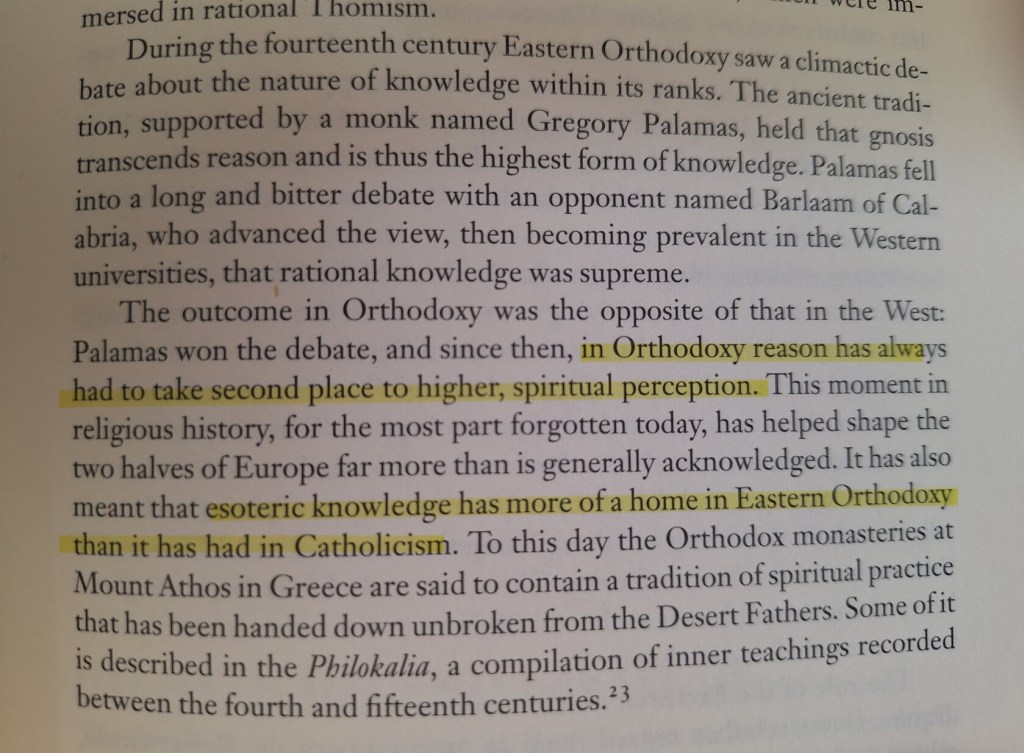
The above picture shows the following quote from “Inner Christianity” by Richard Smoley (emphasis mine):
During the fourteenth century Eastern Orthodoxy saw a climatic debate about the nature of knowledge within its ranks. The ancient tradition, supported by a monk named Gregory Palamas, held that gnosis transcends reason and is thus the highest form of knowledge. Palamas fell into a long and bitter debate with an opponent named Barlaam of Calabria, who advanced the view, then becoming int he Western universities, that rational knowledge was surpreme.
The outcome in Orthodoxy was the opposite of that in the West: Palamas won the debate, and since then, in Orthodoxy reason has always had to take second place to higher, spiritual perception. This moment in religious history, for the most part forgotten today, has helped shape the two halves of Europe far more than is general acknowledged. It has also meant that esoteric knowledge has more of a home in Eastern Orthodoxy than it has had in Catholicism.
I enjoy learning a little bit of the history of the Christian church, aside from the narrow framework I learned growing up in church and at Bible school. Our history is rich, diverse, and compared to other religions, relatively young. But what some Christians may not realize, or perhaps better said, what some Christians may not recognize the importance of, is that the diversity found within has been hotly debated since its inception. These debates were “settled” in one way or another as they came up, from the more disgraceful Crusades where “might was right,” to what has presently culminated to a mind-blowing number of 45,000 plus Christian denominations, whose diverse theologies often contradict one another. But I posit that the importance of these debates are not how they were settled, but the fact that they exist. They point to the reality that there have been and will always be diverse opinions and different interpretations, and insisting that “I am right and you are wrong” proves nothing and convinces no one. It is a “Crusade-esque mindset” that should stay in the history books.
This is not to say that we should strive to adopt every viewpoint we come across as our own. That would be ridiculous and futile. But we can stop falling prey to the fear-driven urge that insists everyone else mirror our own opinions and beliefs, and learn to, instead, respect others.
Esotericism is not new; it is an old, albeit hotly debated tradition. Where we stand on esotericism versus exotericism (that is to say, experiential knowledge versus rational knowledge; or inner knowledge versus outward knowledge) largely depends upon what we have been taught by the culture of the particular religious group we happened to be born into or influenced by, even through inadvertent contact. It has nothing to do with one viewpoint being greater or lesser than the other. It has nothing to do with one viewpoint being wrong and the other correct. In truth, both views, the esoteric and the exoteric, should complement and balance one another. The differences do not make the two incompatible.
Moving forward, I hope we can learn to trust more fully in the Spirit to keep each of us on the right path, and to begin to recognize and appreciate our differences, no matter where Spirit leads.

 Diary of a Christian Mystic