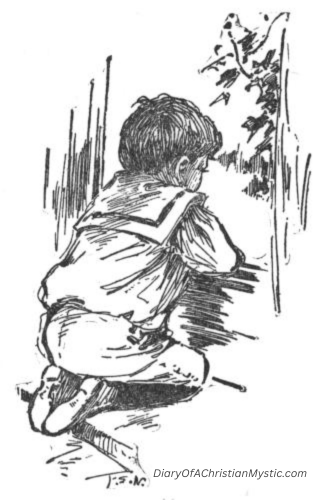
George Learns About Hell
Trevor was one of the first Others I came across in my inner space. I immediately recognized him as the little boy I’d seen on my bedroom floor in the Watermelon house on the day Stepdad had raped me, but not knowing who he was or why he was there, I approached him and asked him for his name.
“My name is Trevor,” he said, “but I don’t like that name.
“Why not?” I asked, not yet having made the connection between the Trevor in my inner world, and the Trevor in the story Mother had told me after she’d beaten me for cutting my hair.
“Because I don’t want die,” he said.
It wasn’t clear to me at the time why the name Trevor would make him afraid of dying, but in my mind, the most reasonable solution was to simply change his name.
“Well,” I responded, “if your name scares you, pick out another one. What do you want your name to be?”
He seemed surprised that he could just change his name, but after he thought about it for a moment, he excitedly exclaimed, “George! I want my name to be George!”
And so Trevor became George.
The importance of this name change for one of my inner selves wasn’t in the name itself; but the significance was in the rejection of the false persona that abuse and fear had created, and it marked when I started thinking about the reality and meaning of who I was as God had created me: my inner self, my true self. It was a very simple change with seemingly little effect at the time, but it was an inward decision that started me on a course that changed my life.
After some time passed, I also changed my name, from my birth name to Loren Grace. This name change is not representative of any importance placed upon my physical self, nor upon any part of me I used to be dissociated from. Rather, it is symbolic of accepting and receiving my inner self, the “Me” created by God, not the “me” shaped by trauma. I don’t downplay the trauma or the impact it had upon me,1 but I reject the false me that trauma had created, and I embrace the true Me. The reborn Me.
Any time I would go inside to find Jesus and talk, he was always surrounded by the younger parts of me, clamoring for his love and attention. George, who had initially been uncertain about Jesus, had grown very attached, and could usually be found in Jesus’s arms, clutching onto his neck while Jesus walked around playing with the children, or sitting on Jesus’s lap when he was sitting down teaching while the younger Others colored.
It seemed odd at first, seeing how Jesus was interacting with the Others in such a casual, easy way, especially the very young parts of me, like George. Not at all like how I’d imagined he would be. The normalcy of his interactions seemed nearly blasphemous, at odds with the images I’d conjured since childhood of what Jesus must have been like. I had thought he would sit somber and serene with a glow around his head like a halo, doing things like reading the Ten Commandments, or reciting the Sermon on the Mount, or studying the scrolls of the Prophets, or meditating in a corner somewhere by himself, praying, while Angels gave him manna to eat. More Bible-y things. Christian-y things, even. But instead, he played hide-and-seek. He read picture books to the children. He colored and put together puzzles with the children. He told stories and jokes. He played pat-a-cake and officiated footraces. He wrestled and played ball. With the older Others, he would go on long walks, and would have conversations with them that I wasn’t always privy to.
He was teaching a very simple spiritual truth to the dissociated parts of me in the way an earthly father should have done: the love of the Heavenly Father that he reflected in word and in deed through everyday interactions.
Not at all the Jesus I’d been expecting.
I continued to spend a lot of time journaling in a “stream of consciousness” fashion, finally able to connect memories, but several months into the process, I was feeling overwhelmed from trying to muck through all the past trauma and trying to live life as normally as possible. Conventional therapy over the years had proven worthless, and so not knowing where else to turn, I took the offer of help from a man I’d been introduced to by friends I had met on social media. He said that he was technically a certified life-coach, but was an expert at helping people like me (I came to realize later, that was a lie) whose mentor was a licensed Christian psychologist (I found out later, that was a lie, too), and he offered me an unconventional therapy that was most similar to what is commonly known as “deliverance ministry.” He admitted the similarities, but insisted it was not deliverance ministry; in practice, however, it was an intense form of deliverance ministry counseling.2
Over the next couple of years, I was led deep into esoteric practices under the guise of spiritual warfare, and what had started off seemingly helpful and innocuous, quickly become increasingly painful, dangerous, and toxic. I had desperately needed help processing incredibly traumatic and distressing memories and to learn better ways of coping in the real world, but all I was getting was more and more involved in spiritual practices that were not only opening me up to the spirit world in harmful ways, but that were also hindering my ability to cope with every day life.
So after nearly two years, I hit the reset button, so to speak, fired my so-called counselor, and purposefully shut myself away from my inner world. Most of the Others got locked away in the rooms that were on either side of the Main Hall, and only Jo, J, and the other Loren were allowed out. Jo and Loren stayed inside the Main Hall, helping to keep order on the inside, and J stood on the outside of the Main Hall, in front of the closed door, where she stood guard. If there was any communication needed between myself and anyone on the inside, J would either act as a intermediary to relay the message, or J would crack open the door to the Main Hall, and that part of me would come to the doorway and talk to me. So I could still see the Others in my mind’s eye and communicate with them. But it was to a much lesser extent. The experience wasn’t as vivid as it had been before, and not as potentially overwhelming for me as it was when I was using meditation to gain entrance into my inner world.
That was the idea, anyway, and for the most part, it worked well enough, except when it came to Starla. She was blissfully unaware and unaffected by the restrictions placed upon her, and she came and went as she pleased, much to my dismay.
Part of my healing process over the next few years included renouncing and separating myself from nearly every spiritual experience I had had during those long months of “counseling.” Since the deliverance ministry process had ended up so horribly and had been so full of deception and confusion, I stopped interacting with the Spiritual Beings I’d been interacting with before, including Jesus, Balthazar (another of my Spirit Guides3), and the Angels. I wasn’t sure if I’d been interacting with the True Jesus Christ, Son of God, or with an antichrist. This confusion and fear, coupled with subsequent teachings that I learned from others who I believed were better educated than me (therefore, in my mind, more capable of knowing the truth than I), led me to the conclusion that such interactions with Jesus, especially in the way that I had been having those interactions, were not of God but of Satan. I came to a similar conclusion concerning interactions with Angels, as well, but I was especially adamant about not interacting with Jesus, period.
But even though I had stopped praying to Jesus and had stopped seeking him out in the way I had before, I didn’t completely dismiss him. Instead, I learned to do what he taught, which became a crucial part of my healing: I learned to pray to the Father; I learned to give every thought and question to God; I learned to verbally and by faith submit myself and every part of myself to the will of God.
And even though I had shut myself off from my internal space, that didn’t mean the spiritual experiences completely stopped. They didn’t.
Some experiences were positive, although the intensity had been greatly reduced. It was less of the “fluff and thrills” of experiential Christianity, and more of the substantive. The fluff and frills are not bad in and of themselves, and the experiential can be an important component of any spiritual path, but there needs to be balance in order for the spirit to grow, and I needed to learn how to balance myself.
I continued to pray and was learning to hear and listen to the voice of the Spirit, and I felt understanding begin to fill me. It was far more subdued and not to the ecstatic levels I had experienced before, but it was just as powerful and meaningful, and the stability of a quieter level of communication with Spirit gave me the space to process and digest the meaning, and to work at applying those principles to my life.
However, the negative experiences still continued, too, the most frightening of which was being pulled out of my body against my will and and harassed in various ways from beings in spirit world.4 But through it all, I heard Spirit tell me to focus on God, my Creator, and not on what was frightening and harassing me. The Spirit told me that in moments of distress, even in the midst of horribly frightening attacks, to surrender myself to God.
And so I began to do just that.
At first, my surrender was coming from a place of blind faith. An immature faith, newly born and vulnerable. I didn’t feel it. I didn’t believe it. But I did it because I knew Spirit had told me to do it. I began verbally surrendering to God: “Father God, I surrender myself and this situation to You. I surrender every part of myself to You. I ask that Your will is accomplished, whatever that may be.”
It was a very simple prayer, one that I could easily remember in times of anxiety and suffering. But it was a very powerful prayer, because it was being spoken with the proper intention of allowing the Spirit to work freely; with the intention of ignoring all else except for Spirit; with the intention of focusing only on those things that were of God, those things which were good; with the intention of focusing on Light rather than on Dark.
But even though fear was decreasing and faith was slowly increasing in many ways—although it would be a few more years before it fully developed—I still struggled greatly. Not only was I still trying to process and learn to cope with a lifetime of trauma and the deep, lingering effects, but I was also easily discouraged, especially when I would try to listen or learn from others about Christian theology. Most everything I was studying and reading would trigger a deeply-rooted fear within me that God had created me to be against Him, and that no matter what I did or didn’t do, God was going to send me to Hell anyway. I’d eventually come to a place of understanding and peace within myself, but then something else would happen to trigger that fear—an abduction or a demonic attack; being rejected or gaslighted or lied about by yet another Christian friend; reading a Bible study that Reverend So-and-So had written—and I would begin fighting that fear all over again.
At the same time, I was struggling with Starla, one of the Others who I believed at the time was Luciferian because of the slant of her beliefs that she would constantly share with me regardless of how much I tried to shut her up. She was always pressuring me, sometimes subtly, sometimes not-so-subtly, to take another look at some of the beliefs and practices I had discarded, and her constant interjections and observations added to my internal stress, as well.
Sometime in mid-2021, I finally came to a place where I fully faced my deepest fear, and accepted it as being true: that I was doomed from the very beginning of my existence to an eternity of hell, regardless of my love for and desire to please God. And in spite of believing that what would please God was also what would doom me to an existence without Him, I finally resigned myself to what I had been fighting against the vast majority of my life, and said, “Okay, God, not my will, but Yours be done. If You want me to work against You, then that’s what I’ll do.”
And I decided to make a truce with Starla, since she had been so insistent.
Immediately I was inside my inner world again, in the Main Hall, and Balthazar, the Spirit Guide I had previously kicked out, marched back in. I wasn’t happy to see him.
“Oh great,” I thought, rolling my eyes. “Here we go again,”
But he just looked at me with a huge grin on his face and laughed, then he walked over to me and leaned in close, his demeanor suddenly very serious. “Do you believe Jesus Christ is the Son of God?” he asked.
Balthazar had always been so jovial with me in the past, so the stern look directed towards me felt a little scary, but the words he asked startled me, and my heart was stabbed with pain, as if I were being punished by being forced to confess my belief in Jesus while at the same time being pushed into working against him. It didn’t feel fair. It felt rather cruel, but I exclaimed loudly, “Yes, of course I believe that Jesus Christ is the Son of God!”
Then he asked, “Do you deny Christ?”
I felt anger start to bubble inside of me. “No! Of course not! He has denied me, not the other way around!”
Balthazar just looked at me, his countenance motionless, like a stone, and believing his expression to be conveying anger, I became even more infuriated.
“How dare he be angry at me!” I thought, incensed at the nerve he had to ask me such a question. So I yelled again: “I may be working for you and whoever else now, but I won’t deny Christ, and if that’s a condition of my cooperation, then you’ll have to find someone else because I won’t do it!”
He stared at me for a moment longer, and I stubbornly stared back at him, fuming, and then he turned and walked out of my inner space.
I was shaking and frightened at the thought of having made him angry (so I thought), but I was too angry myself to really care much about the consequences, and I couldn’t imagine how it could be worse.
Some time later—days or weeks, I can’t remember—Balthazar strolled back into my inner space, Jesus close on his heels.
I rolled my eyes again. “Great,” I thought. “Just great… why does he have to be here?” And I asked Balthazar the same: “Why is he here?”
But Balthazar didn’t answer, and Jesus didn’t even look at me. He just walked right past me, and went to the Others who were gathered together on the other side of the hall, waiting anxiously for him. I was dismayed and more than a little resentful when they all greeted Jesus with such joy. I watched as the little ones jumped around him, saw the smiles and heard the laughter. I watched as they each tried to get his attention in different ways, some by jumping in front of him, some by tackling his legs or jumping on his back, some by standing shyly to one side, flushing and smiling when his gaze met theirs. I watched as Jesus turned to each of them, one by one, with a smile or a soft touch to the face or a kind word or a happy laugh or a tussle of the hair or a sweeping hug.
I watched and I was angry. How could they not remember what we had learned, that it was not a Godly thing to interact with Jesus, that it wasn’t Biblical, that it wasn’t of God? How could they forget that Jesus was in Heaven, on the throne beside God, that his work was already complete and finished, and that he had nothing more to do except sit around in Heaven, and maybe even do things up in Heaven, but certainly not do things on Earth? How could they betray me in such a way!
But I decided to ignore the whole situation. It was out of my hands. I wanted nothing to do with this Jesus, this antichrist, and I wasn’t going to interact with him unless I absolutely had to. “I’m not talking to him,” I told Balthazar.
“That’s okay. You don’t have to,” he responded.
A short time later—days? weeks? I’m not sure—Balthazar came again and brought Starla and I to the pool that Jesus had built some years before. It was a peculiar pool like one I’d never seen before,5 made up of three separate pools, two that were side-by-side and connected by a hole in the separating wall, and the other buried under the ground of the second one, keeping it filled up from below. Water also flowed down three of the four walls of the room, the overflow of which would somehow make its way into one of the pools in the center of the room, and behind one of the waterfalls, there was not a concrete wall as with the others, but passage into another dimension, a place in the spirit realm that Jesus and Balthazar would sometimes take me.
During my internal reset a few years prior, I had locked the door to the room where the Mikveh was and bolted it securely before shutting myself out of my inner world, so I wasn’t happy that Balthazar opened it back up again. But I was attempting to be more cooperative, so I said nothing, followed Starla into the Living Water, and allowed Balthazar to lead her and I into a type of integration. It wasn’t a complete integration at that point, but it was a partial integration that brought closer understanding and acceptance between the two of us.
As the days turned into months, my life became calmer. I started feeling more peace, I was able to function better with everyday tasks, and I was able to enjoy and fully engage in time with my family.
I would often go into my inner world through meditation and just sit on a bench in the middle of the Main Hall and observe, not really sure what my role was. Balthazar would often come sit beside me, silent, watching the activity with me.
Angels would come and go sometimes, and although I still didn’t feel comfortable initiating conversation with them, they seemed innocuous enough, so I didn’t protest their presence.
Jesus continued his work with the other parts of me, George shadowing his every move. Sometimes I would get a strange feeling watching everyone else interact with Jesus. It was a happy feeling, but it also nearly felt like jealousy, which was admittedly rather bizarre, since the Others were me and I was them.
I began to slowly realize that Jesus, who with such love and gentleness was bringing me and every part of me into healing and wholeness, wasn’t an antichrist as I had feared he was. I began to realize that he wasn’t a deception, but that he was exactly who he’s always claimed to be: the Son of God. And I realized that I wasn’t working for or being asked to work for Satan at all. In fact, I wasn’t even being asked to do anything at all, but to just trust the healing process that God, through the work of Jesus, Balthazar, and the Angels, was bringing me through.
I began to realize that on the day Balthazar had re-entered into my Inner World, he had not asked me if I would deny Christ, but he had been asking me if I had denied Christ. There’s a very distinct, yet subtle nuance, and Balthazar had simply wanted me to recognize and to confess that I would not deny Christ.
Then Balthazar began working with me specifically on a concept he called “Receiving.”6 It seemed like such a simple concept, and it is, but I was surprised at how much work it took to simply receive, to open my whole self to the Spirit and to allow God to move through me. I had always thought of approaching God—had actually been taught to approach God—with the attitude of giving something to God.
But Balthazar told me, “God has no need of anything.”
And I began to see that everything I’d been taught to give to God out of love for Him—praise, worship, money, time, energy— had been coming not from a place of love, but from a place of fear. I feared God,7 and so I had sacrificed to God everything I could—my whole life and my whole self—in an attempt to appease His wrath and to invoke His blessing.
Balthazar began teaching me, however, that to “give myself to God” simply meant to surrender to God and to receive of God. That’s it. That’s the only thing you ever need to learn in life about God: to surrender to God and to receive of God through the Holy Spirit. Everything else is built upon that.
Early one morning, I entered into my inner space and was met with George’s adorable little babyface. Jesus and Balthazar were nearby, observing.
I bent down to give George a hug, and he stood up on his tippy-toes, whispering something in my ear.
Although I couldn’t quite catch what he’d said, I felt a chill of foreboding, and I stood back up straight, looking down at his smiling face. “What?” I asked him. “What did you say?”
But he just looked up at me and smiled.
I turned to Balthazar, and then to Jesus. “What did he say? What was that?”
Then I looked back at George and I heard in my mind, “it’s time,” and George slowly started getting taller and older. I watched as he began transforming into a young woman—me, as I’d looked as a young woman—feeling horrified that George was simply going away. Then George, looking like me as a fully grown woman, stepped forward and hugged me tightly, and then disappeared.
Integrated in an instant, and I wasn’t prepared for it. I began crying. I didn’t want it to happen. I loved little George, and I loved being able to go inside and see him playing and even talk to him sometimes. He was so full of curiosity and had a love for life, full of innocence and faith and love. I didn’t want to let go of him.
Jesus took hold of my hand and pulled me to a bench, where he sat down beside me, pulled me close, and wrapped his large shawl around me, almost completely covering the both of us. I had forgotten about his shawl until just then. I didn’t know why, but I always had the warmest feeling all wrapped up inside his shawl, safe and loved and completely whole, and I sat there with Jesus for a very long time, receiving his healing light and love.
A couple days later, I started thinking about George again, and the trauma that had caused him to split off from me. And I realized that George had split off because of that story Mother had told us about Trevor. George had not only been afraid that he might grow up and do something bad to to die and go to Hell, but he had also been afraid that Jesus-God would kill him before he could even grow up!
Either way, it wasn’t a situation George could win, so he decided to not grow up. It seemed to be a reasonable solution to a two-year old.
But spending time with Jesus, who had so perfectly and with such gentleness, expressed the Love of God to every part of me, all of George’s fears had been eradicated, and so he had integrated.
George had learned the truth about Hell, and he was no longer afraid.
And I realized that I was no longer afraid of God, either. I was no longer afraid of being sent to Hell, either. God did not hate me. God did create me, as I had feared my entire life, for the singular purpose of punishing me in an eternal fire of agony. I realized the truth that when this body dies, I will live on forever, throughout eternity, protected and secure in the presence of the Divine, growing and living and learning, just as I am now.
I realized that Hell, as defined by Christian churches and other religions for reasons of control, did not exist. Rather, I learned that Hell in its many different forms is an extension of God, because there is nothing that exists outside of God. Yes, Hell is the Eternal Fire of God that burns away everything that does not belong, including sin (which is another misunderstood topic; see: Behind the Veil), and no one who works evil will escape judgement. There will be justice, because God is a God of Mercy and of Judgement, and Mercy demands Judgement. But Judgement is also forever balanced by Mercy, and Hell is not a process that is for the eternal conscious torment of a large portion of non-Christian humanity. Instead, it is a process that is meant to cleanse the soul of unrighteousness for the purpose of bringing healing to the soul and reconciliation with the Divine, and this will either take place in the physical, as intended, or in the afterlife.
But aside from that form of Hell, the Fire of God also protects us, and it purifies and perfects our faith. And I realized that I had already gone through Hell, and would continue to walk through Hell, allowing the Fire of God to purify and to perfect my faith, to burn away all of the fear and brainwashed ideas about God that was keeping me from communion and Unity with God through the Spirit, and to protect my soul in preparation for the day I would be set free of the physical.
And so I learned the Truth about Hell, and I was no longer afraid.
See also: Behind the Veil and God Raised Me Up
Footnotes
- “I don’t downplay the trauma or the impact it had upon me” — see: God Raised Me Up.
↩︎ - Deliverance Ministry — essentially a type of Christian counseling (not to be confused with licensed mental health therapy) whereby a type of spiritual warfare is engaged during sessions in an effort to be set free from past trauma. I don’t have personal experience with different types of deliverance counseling, and maybe some are less extreme and more helpful than others; but in my situation, this warfare involved using what was essentially my psychic ability (spiritual gifts is a more Christian-y way to say it) and the open doors of my inner world to navigate and engage the spirit world in ways that were very unwise. I don’t write much about it here except in passing, but this was overall a very negative experience for me. You can read about some of my experiences in the following post: “Healing from Psychological and Spiritual Manipulation Within Deliverance Ministry.” Portions of this chapter were detailed in my blog post titled “Navigating Spiritual Deception and Discovery”, but I’ve decided to take it down and just quote some of it here. You can read the original here on my previous website, on LorenGrace.com.
↩︎ - Spirit Guide — this simply means a mentor or guide in the spirit realm, as opposed to a mentor or guide in the physical world. They can include human entities, such as Jesus, or non-human, such as Angels. It is my belief that we should first and foremost seek to be led by the Spirit of God, and then those Guides who are themselves led by the Spirit, whether in the physical or in the spiritual, will come along if and when we need them.
↩︎ - “beings in spirit world” — Christian theology usually categorizes spiritual entities as either being Angels or Demons. For a basic understanding, this is fine, and as long as activities don’t venture outside of that basic understanding, then it’s harmless. But the spirit world is not so cut-and-dry. Not every light entity is an Angel, and not every dark entity is a Demon. There are also human entities that navigate the spirit realms, as well as hybrids and non-human, and their intentions vary, some more positive, some more negative, and others are neutral. Sometimes there’s also more to things than meets the eye (so to speak), as I’ve also seen instances where Angels and what appeared to be Demons were working together for the common purpose of furthering God’s Divine Will in particular situations. The point being, it’s not as cut-and-dried as Angels or Demons. But that’s a good place to start, and if that’s where the understanding prefers to stay, then that’s okay, too.
↩︎ - “a peculiar pool” — much later, I learned this pool was called a Mikveh, and is an integral part of Jewish tradition.
↩︎ - Receiving — several years later, I came to understand that receiving is the very basic foundation behind Kabbalah, commonly understood as Jewish mysticism.
↩︎ - “I feared God” — this fear was not the extreme “awe and respect” towards an All-Powerful God that is spoken of in Scripture, but was the crippling, terrifying fear that hindered my spiritual growth.
↩︎
Navigation
Chapter One: Trevor
Chapter Two: Inner World
Chapter Three: Leaving the Inner World
⇐ Chapter Four: Re-entry
Chapter Five: George Learns About Hell
⇒ Chapter Six: The House That Jesus Built
 Diary of a Christian Mystic